HR software where the clock and the payslip are one system
A shift with a grace period and an overtime cap, attendance measured against it, and pay heads that add or deduct on what that attendance says. The month’s wage bill is a figure in the ledger before anyone has been paid.
Nobody keys a net figure. It is what falls out of the shift somebody was on, the hours they were there, the days they were allowed off and the heads you decided to pay by.
The shift
Grace in and out
Minimum hours
Overtime cap
Attendance
Days present
Overtime requests
Leave & holidays
Leave type
Applications
Holiday calendar
Pay heads
Basic, overtime, bonus
Late fee, early out
One salary sheet
Per period, per payroll, with every head itemised and payable, paid and due for each person — and the wage bill posted to the ledger as a liability whether or not it has gone out yet.
Which is the part most payroll spreadsheets miss: the month you have worked but not yet paid is money you owe, and it should be on the balance sheet on the last day of it.
What is in it
Everything the HR & Payroll module covers
Employee Management
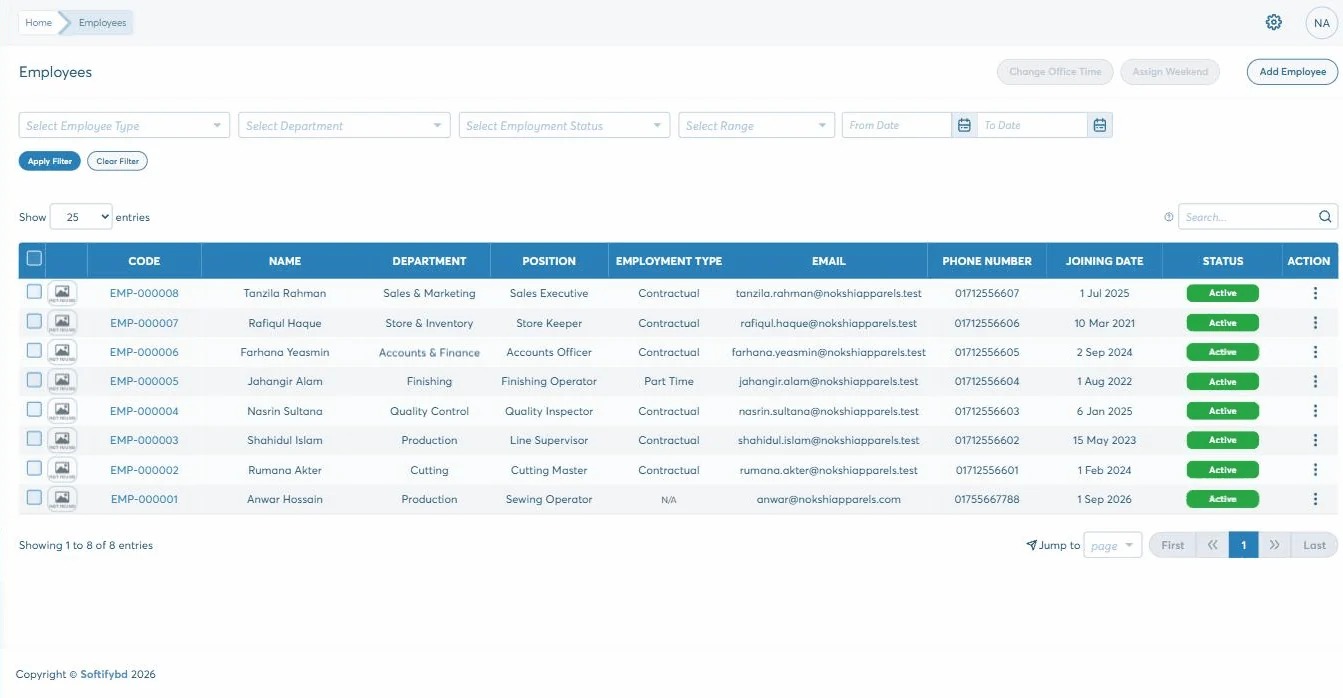
A record that goes well past a name and a phone number — addresses down to thana, family and national ID details, dependants, education, previous jobs and references, each on its own tab.
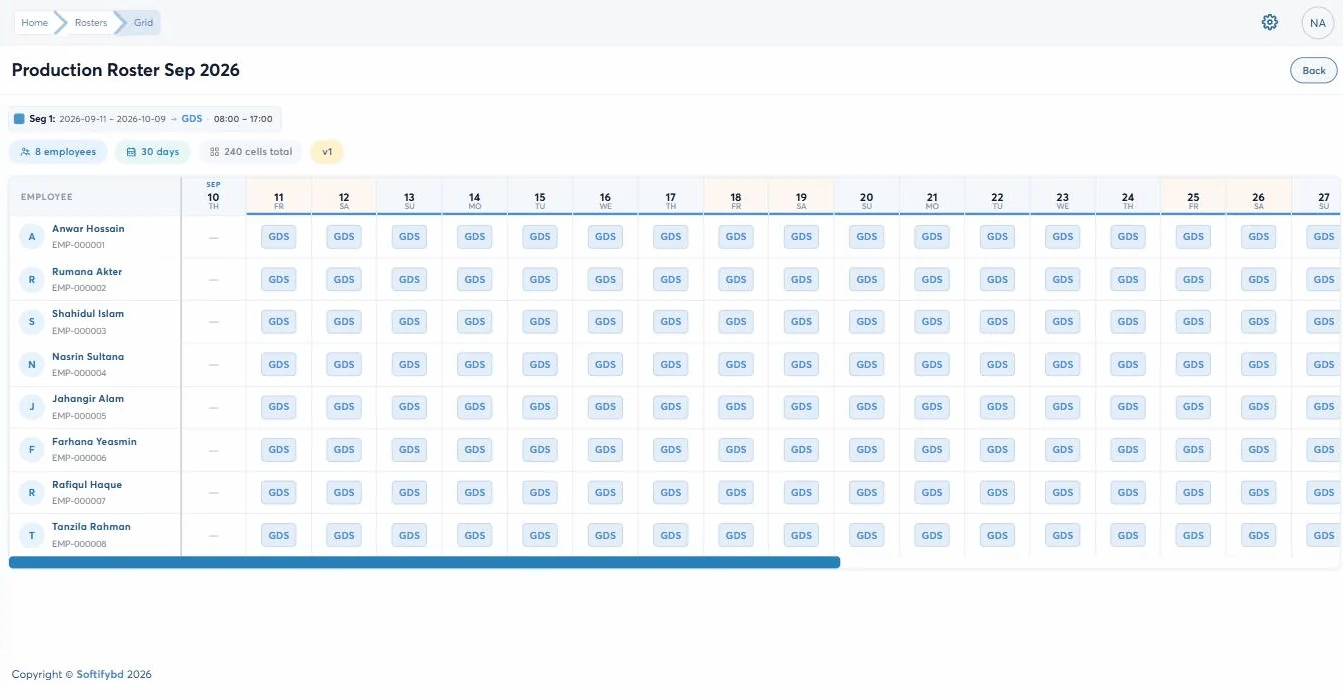
Against a shift that knows its own rules: start and finish, the break, the grace you allow either side, the minimum hours that count as a day and the cap on overtime.
Pay heads you define, each one an addition or a deduction — basic, overtime, incentive and bonus one way, late fee and early out the other. A payroll has its own cycle and payment method.
The sheet for a period, read payroll-wise or employee-wise, showing every pay head with its amount and then payable, paid and still due for each person.
Leave types you define and assign, applications against them, and a holiday calendar — so a day off is one of three different things and the attendance sheet knows which.
Set up once, then four things happen every month and only one of them is typing.
Say what a day is
A shift with its hours, its break, how late is late, how few hours still count as a day, and how much overtime you will allow.
Time
Break
Grace in / out
Minimum hours
OT cap
Record who turned up
An attendance sheet per day, filtered by department or position, with overtime as its own request rather than an assumption.
Date
Department
Status
OT request
Handle the days off
Leave types you define, applications against them, and a holiday calendar — so absence, leave and a public holiday are three different things.
Leave type
Application
Holiday
Weekend
Run the sheet
For a period and a payroll. Every head itemised, payable and paid and due per person, and payslips from the same figures.
Period
Payroll
Pay heads
Payslip
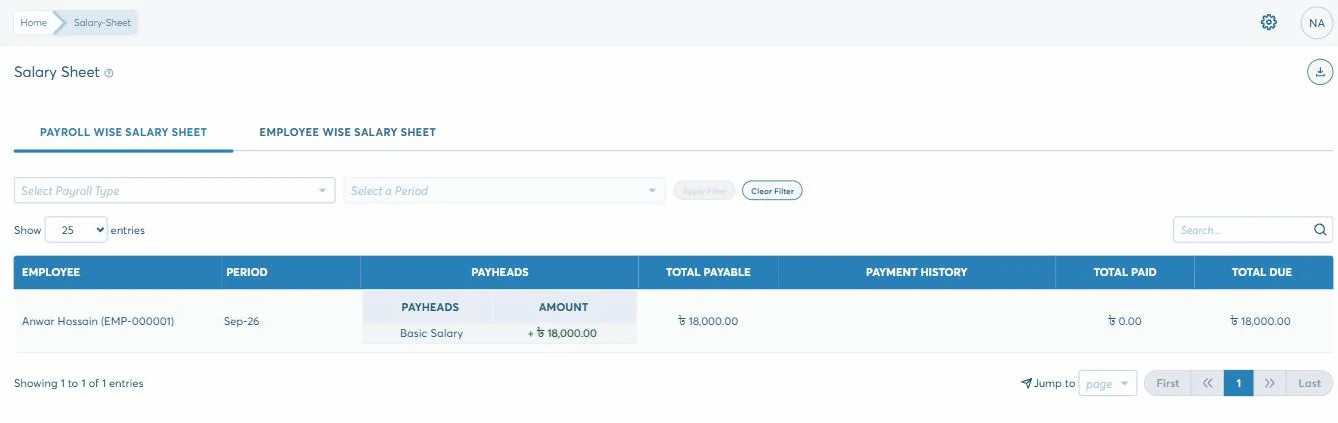
September’s sheet — every pay head itemised, then payable, paid and still due. That last figure is the one sitting in the ledger.
How it holds
Two things that make a wage argument short
Pay disputes are almost never about the rate. They are about what counted as a day and what counted as late.
The rules are written down before the month starts
A shift is 8:00 to 5:00 with an hour’s break, ten minutes’ grace either side, 7.67 hours as the minimum that counts, and overtime capped at 120 minutes. Every one of those is a field you set, not a supervisor’s judgement — so a late fee has a definition behind it that both of you can read.
Total debit48,500.00
Total credit48,500.00
Difference0.00
Earned and paid are two different columns
The salary sheet carries total payable, total paid and total due for each person, and the unpaid part sits in the ledger as Payroll Liabilities. September’s 18,000 was owed and on the balance sheet before a taka of it moved, which is what stops a wage bill being invisible until the day it clears.
Payable
Partly paid
Paid
Overtime is a request rather than a calculation, so hours somebody worked late are approved by a person before they are paid for.
Why it matters
Why payroll comes off the spreadsheet
Payroll on a spreadsheet works until somebody disputes a deduction, until an auditor asks what the unpaid wage bill was on the 30th, or until the person who maintains it is on leave.
What counts as late, as a full day and as overtime is written down in advance
Deductions come off recorded attendance, not off a supervisor’s memory
Overtime is approved as a request before it is ever paid
The unpaid wage bill is on the balance sheet the day it is earned
Payable, paid and due are three separate figures per person
An employee record holds the ID, family and address details a compliance check asks for
What comes out
What you can pull for a month
The salary sheet reads two ways — payroll-wise or employee-wise — which covers most of what gets asked.
The people
The roster
1 of 2
And the last one is not an HR report. It is Payroll Liabilities on the balance sheet, which is the same 18,000 the salary sheet says is still due — one figure, arrived at once.
Getting started
How HR and payroll gets running
How long it takes depends on how you work and what has to come across from wherever it lives now. That is what the second step is for — and nothing is committed before it.
1
Start the trial
30 days, no card, nothing to install. Put a real week of your own work through it rather than a demo of ours.
2
A short discovery
We go through how you actually work — the documents, who should see what, and what has to come across into HR and payroll.
3
Set up and trained
Modules configured to that, roles set screen by screen, and your team taken through the parts they will each use.
4
Live, and still answered
Phone, email or online, from the team that built it. Nobody hands you to a reseller once the invoice is paid.
Questions
What an HR manager asks about it
Can I set how much lateness is allowed before it costs anything?
Yes — a shift carries a grace period in and out, a minimum number of hours that still counts as a day, and a cap on overtime. Late fee and early out are pay heads of type Deduction, so they act on what those rules produce.
Are overtime hours paid automatically?
No, and deliberately. Overtime is its own request, approved before it is paid, and the shift carries a cap on how much can be claimed. Overtime is then an addition-type pay head like any other.
Can I add our own allowances and deductions?
That is what pay heads are. Each one is named, described and typed as an addition or a deduction — basic salary, overtime, incentive and bonus on one side, late fee and early out on the other — and you can add your own.
Does the wage bill reach the accounts?
Yes, as a liability. The salary sheet’s total due shows in the ledger as Payroll Liabilities, so a month that has been worked but not paid is on the balance sheet rather than appearing only when the money leaves.
How is leave different from absence?
Leave types are defined and assigned, and an employee applies against one. Holidays are their own calendar, and weekends are assigned in bulk. So a day somebody is not at work is leave, a holiday, a weekend or an absence — four different things, not one blank cell.
What does an employee record actually hold?
Beyond the work details — present and permanent addresses down to thana, national ID and passport, blood group, family details including parents’ national IDs, dependants, education, previous employment and references, each on its own tab.