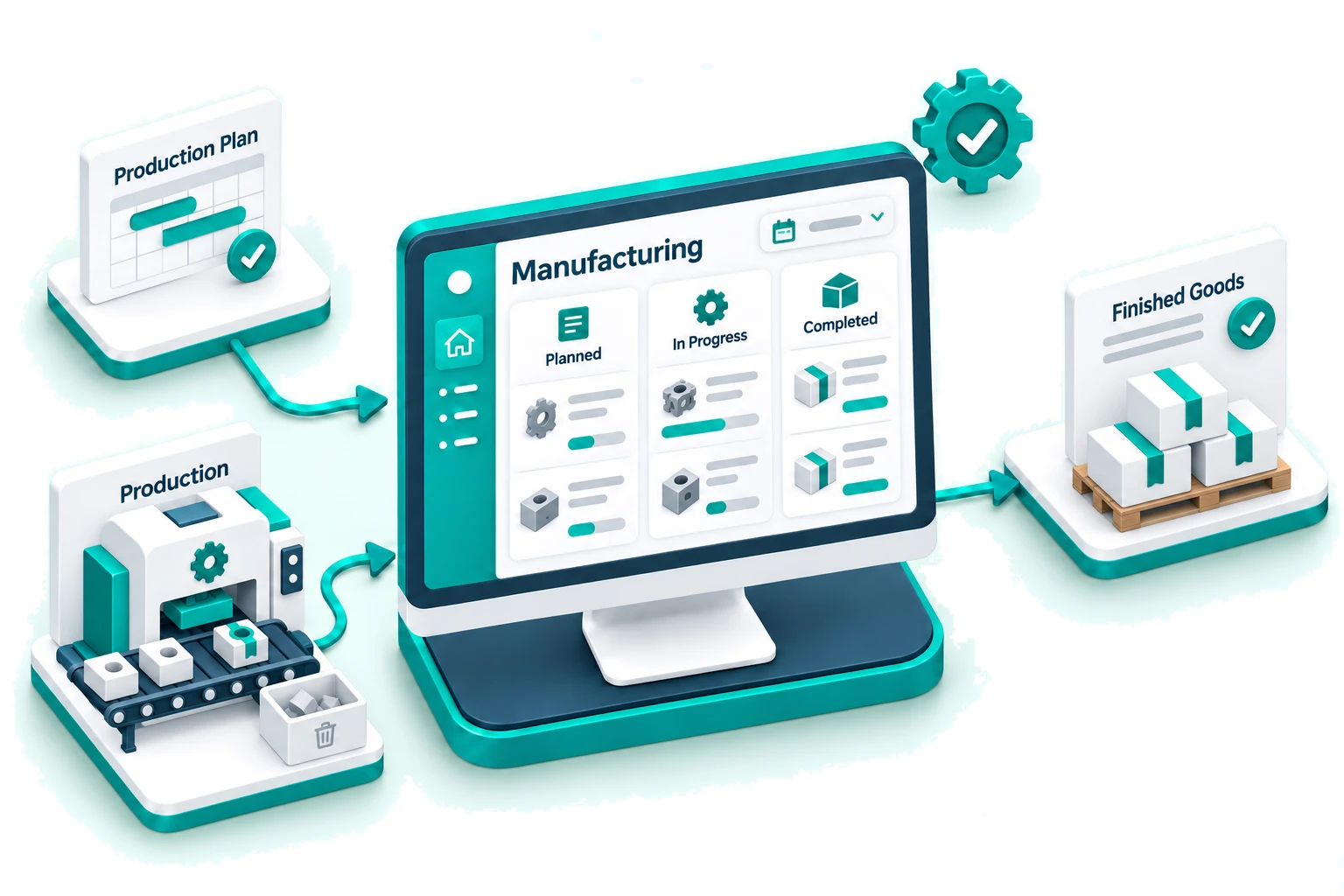
Manufacturing software that costs the scrap as well
A plan works out what a unit costs before anything is cut. What comes off the line is counted as finished or as waste, both at that cost — so the run reconciles, and the loss is a figure in the ledger rather than a shrug.
Four things have to be real before a run can start: an item to make, the materials to make it from, somewhere they actually are, and somebody whose name is on it.
Item
The item to produce
Saved template
Inventory
Quantity in stock, live
Warehouse to draw from
Purchase
Raw material received
What it cost
Your team
Production team
Responsible person
One costed plan
Total amount, total quantity and cost per unit, worked out from the material lines as you add them — before a single piece is made.
Leave the material list empty and the form says so: “Please add stock details to proceed with plan approval.” A plan with no bill of materials can be saved as a draft, and cannot be approved.
What is in it
Everything the Manufacturing module covers
Production Planning
Pick the item, the quantity and the dates, list the raw materials against their live stock, and the per-unit cost is worked out as you type. Assign a team and a responsible person before it can be approved.
Save a plan’s material list as a template and the next run of the same item starts filled in. Link a plan to a work order, or to a customer when it is being made to order.
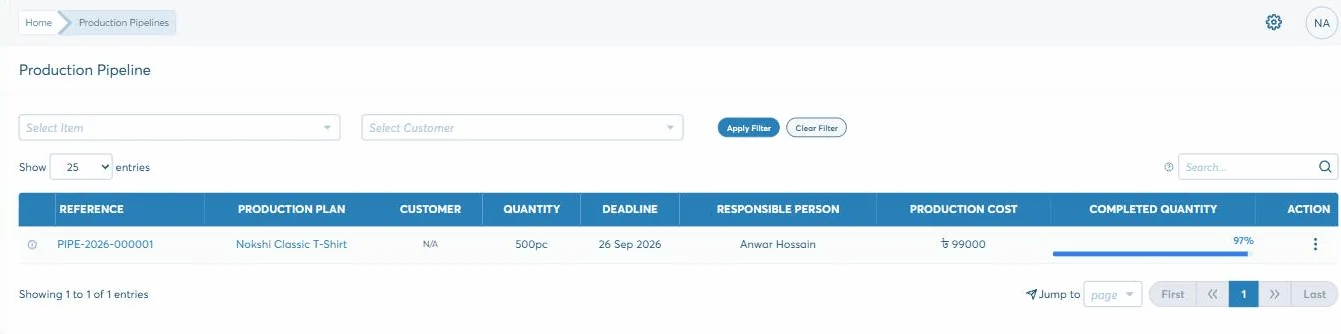
A board per run, with cards moving through Open, Working-Process, On-Hold and Completed. The list shows each run’s cost and how far through it is, as a percentage.
What came off the line, at the plan’s unit cost, with how much of it has been transferred into sellable inventory — all of it, some of it, or none yet.
Four stages, and the quantity is carried through all four rather than re-entered at each one.
Plan and cost it
The item, the quantity, the dates, the materials against their live stock. The per-unit cost appears as you go.
Item
Quantity
Raw materials
Cost per unit
Put it on the board
Each run becomes a pipeline with a Kanban board — cards move through Open, Working-Process, On-Hold and Completed.
Open
Working-Process
On-Hold
Completed
Count what came out
Good pieces go to Finished Goods, bad ones to Waste Goods, both against the plan and both at its unit cost.
Finished quantity
Waste quantity
Unit cost
Responsible
Hand it to inventory
Finished goods are transferred into sellable stock — all, some or none of them, and the status says which.
Transferred quantity
Transfer status
Warehouse
A run with what it costs and how far through it is. This one is 97% of 500 — which is the 485 finished and 15 scrapped the page describes.
How it holds
Two things that keep a run honest
Both are about the gap between what you planned to make and what you actually have on a shelf at the end of it.
Finished plus waste has to come to what you started
Five hundred planned came out as 485 finished and 15 scrapped, and both records carry the plan’s own unit cost. So the run reconciles on quantity and on money at the same time: 96,030 of sellable goods and 2,970 of loss against a 99,000 plan. Nothing is rounded away, and the scrap is not simply absent.
Total debit48,500.00
Total credit48,500.00
Difference0.00
Finishing something is not the same as having it to sell
Output sits in Finished Goods until it is transferred into inventory, and the record says whether that has happened for all of it, some of it or none. Waste is never transferred at all — which is how 15 pieces of scrap stay a cost rather than quietly becoming stock somebody expects to sell.
Not transferred
Partially
Transferred
Every plan also takes an internal note and up to 5MB of attachments, so a spec sheet or a customer drawing stays with the run.
Why it matters
Why a factory stops costing jobs afterwards
Most small manufacturers find out what a run cost once it is over, by adding up invoices. By then the price has already been quoted.
The per-unit cost is on the screen before the run is approved, not after it ships
A plan cannot be approved without a material list — the form refuses
Scrap is counted and costed, so waste is a number you can argue with
Material quantities are checked against live stock, not against memory
Every run has a named responsible person and a team on it
Finished output becomes sellable only when somebody transfers it
What comes out
What the factory floor gives you back
Mostly on the lists themselves, because the figures that matter here are per run rather than per month.
Cost per unit, per plan
How far through each run is, as a percentage
Finished against waste, per plan
Output still to be transferred into stock
Runs by item
Runs by customer, where they are made to order
Runs by responsible person
Scrap value in the ledger
That last one is not a report either. The 15 scrapped pieces at 198 each are the 2,970 sitting in Work-In-Process Inventory on the balance sheet — the same number, because it is the same event.
Getting started
How manufacturing gets running
How long it takes depends on how you work and what has to come across from wherever it lives now. That is what the second step is for — and nothing is committed before it.
1
Start the trial
30 days, no card, nothing to install. Put a real week of your own work through it rather than a demo of ours.
2
A short discovery
We go through how you actually work — the documents, who should see what, and what has to come across into manufacturing.
3
Set up and trained
Modules configured to that, roles set screen by screen, and your team taken through the parts they will each use.
4
Live, and still answered
Phone, email or online, from the team that built it. Nobody hands you to a reseller once the invoice is paid.
Questions
What a production manager asks about it
Does it work out what a unit costs before I commit?
Yes. You list the raw materials and their quantities on the plan and the total amount, total production quantity and per-unit cost are calculated as you type. The plan cannot be approved with an empty material list.
Can I reuse a bill of materials?
Yes. Tick "save as template" on a plan and it joins your template list; the next run of that item starts from it. A plan can also be tied to a work order or to a customer when it is being made to order.
How do I see where a run has got to?
Each run has a pipeline with a board — Open, Working-Process, On-Hold, Completed — and the pipeline list shows completion as a percentage beside the run’s cost and deadline.
What happens to pieces that fail?
They go to Waste Goods against the same plan, at the same unit cost, and they are never transferred into inventory. Good and bad together come back to the quantity you planned, so the run balances instead of losing a few pieces along the way.
Does finished output go into stock automatically?
It is an explicit transfer, and the record tracks how much of the output has been moved — transferred, partially transferred or not transferred. That way something sitting finished in the factory is not counted as available to sell.
Does it track labour time?
There is a labour time field on finished and waste records, but it is not being captured — it reads zero on every run, so nothing on this page depends on it. Costing today comes from materials and the plan’s own unit cost. Ask us where it stands before you plan around it.