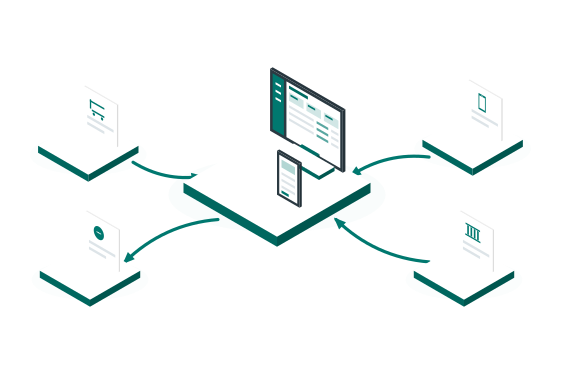
The shop takes the order. Biznify does the rest — the stock it came out of, the invoice, the payment against it, the parcel and the entry in the accounts. A live API keeps both sides on the same figures, so selling online does not mean maintaining the same records twice.
It arrives tagged as one so you can tell it apart, and then it does exactly what every other order does. That is the whole integration: not a bridge between two systems, but one system the shop writes to.
Inventory
The same available stock
The same warehouse
Accounting
Sales
Accounts Receivable
Sales Tax Payable
Delivery
Delivery channel
Consignment ID
Channel charge
Notifications
SMS templates
Email templates
An order from the shop
Tagged Ecommerce on the same order list your sales desk already works in, against the same customer record.
Which is why there is no import step, no nightly job and no window during which the website and the warehouse disagree.
What is in it
Everything the Integrated E-Commerce module covers
Product Catalog Sync
One catalogue. What you list, price and describe in the ERP is what the shop shows, without anybody copying it across.
Your team does this in the screens they already use. Nothing about an online order sends them somewhere else.
The order arrives
On the same list as everything else, marked Ecommerce, with its own column so you can filter the channel in or out.
Order type
Customer
Lines
Grand total
Stock is committed
Against the warehouse it will ship from — the same figure the shop was selling against, so it cannot go twice.
Warehouse
Available stock
Delivery
A courier takes it
Pick the delivery channel, record the charge and keep the consignment ID on the delivery, so the parcel is traceable from the order it belongs to.
Delivery channel
Channel charge
Consignment ID
Status
The books catch up on their own
Invoice, payment, revenue, VAT and the customer’s balance — all of it posted by the documents rather than typed at month end.
Invoice
Payment method
Ledger
Customer balance
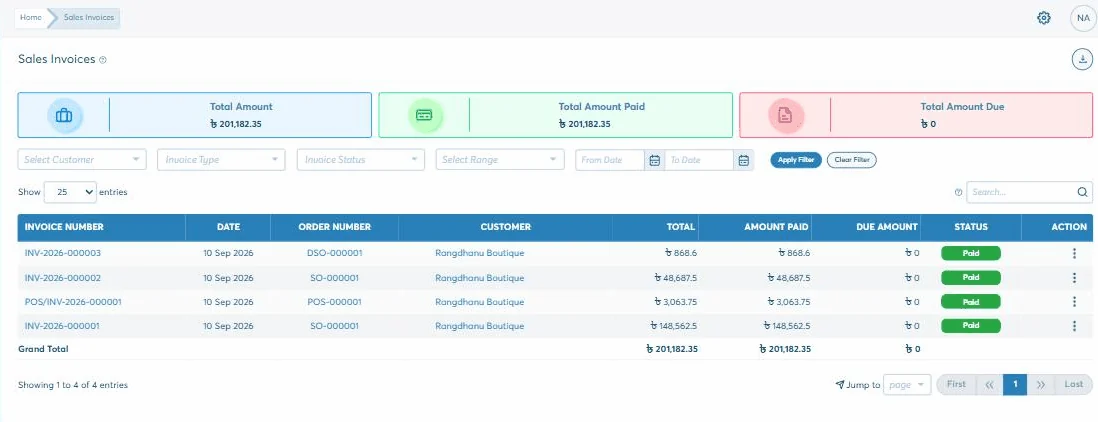
Order invoices, direct sales and counter sales in one list, under one set of totals. An online order joins the same list, on the same terms.
How it holds
Two things that go wrong when the shop is its own system
Almost every online-selling problem we get asked about is one of these two, and both come from keeping stock in two places.
The website sells the warehouse’s figure, not a copy of it
When a storefront keeps its own stock table, the gap between one sync and the next is the window you oversell in. Here the shop reads the same available figure the storeroom works to — the one a goods receipt, a counter sale and a production run all move. There is no copy to fall behind.
Total debit48,500.00
Total credit48,500.00
Difference0.00
The channel is a label, not a second business
An order is tagged Standard or Ecommerce and then treated identically. You can report on the channel and you never have to reconcile it — online sales, desk sales and counter sales land in one invoice list under one set of running totals.
Tagged
Fulfilled
Posted
Payment gateways, couriers and SMS providers are configured once, in Biznify, and used by whichever channel needs them.
Why it matters
Why the shop should not have its own database
A storefront joined to an ERP by nightly export works fine until the day you sell well. Then the two disagree, and the customer finds out before you do.
The website and the warehouse read one stock figure, so a unit cannot go twice
Online orders sit in the list your team already works from
The channel is a filter, not a second set of books to reconcile
Couriers, gateways and SMS are set up once and shared by every channel
Somebody who buys online and in the shop is one record with one balance
Revenue from the website reaches the ledger as it happens, not at month end
What comes out
What selling online lets you ask
The useful questions here are comparisons, and comparisons only work when both sides are measured the same way.
Online orders against desk and counter orders
Revenue by channel, on one set of books
Stock committed to unfulfilled online orders
Deliveries by courier
Delivery charges by channel
Online orders not yet dispatched
Payment method split across channels
One customer across every channel they buy through
That last one is the quiet advantage. Somebody who orders on the website on Monday and walks into the shop on Friday is one record with one balance, not two strangers.
Getting started
How integrated e-commerce gets running
How long it takes depends on how you work and what has to come across from wherever it lives now. That is what the second step is for — and nothing is committed before it.
1
Start the trial
30 days, no card, nothing to install. Put a real week of your own work through it rather than a demo of ours.
2
A short discovery
We go through how you actually work — the documents, who should see what, and what has to come across into integrated e-commerce.
3
Set up and trained
Modules configured to that, roles set screen by screen, and your team taken through the parts they will each use.
4
Live, and still answered
Phone, email or online, from the team that built it. Nobody hands you to a reseller once the invoice is paid.
Questions
What an online seller asks about it
Will the website and my warehouse ever disagree?
They are not two numbers. The storefront sells against the same available stock the warehouse works to — the figure moved by goods receipts, counter sales and production runs. There is no sync interval, so there is no window to oversell in.
Do online orders go somewhere separate?
No. They arrive on the same sales order list, tagged Ecommerce, with their own column and filter so you can isolate the channel when you want to. Everything after that — delivery, invoice, payment, ledger — is identical to any other order.
Which couriers and payment gateways does it work with?
bKash, Nagad and SSLCommerz for payment; eCourier, Pathao and REDX for delivery; Elitbuzz, Khudebarta and Reve for SMS. A delivery record carries its channel, the charge and the consignment ID, so a parcel is traceable from the order it belongs to.
Can customers be told what is happening with their order?
SMS and email templates are configured in Biznify and used by whichever channel needs them, so the message a website customer gets comes from the same place as everything else rather than from a separate plugin with its own settings.
Is a website customer the same record as a walk-in?
Yes, where it is the same person or firm. One customer page carries their online orders, their counter purchases and their balance together — the thing two separate systems can never give you.
What if I already have a store built on something else?
Then the honest answer depends on what it is built on, and we would rather look than promise. Biznify also publishes website templates that come wired up from the start. Tell us what you are running now and we will say plainly what connects and what does not.