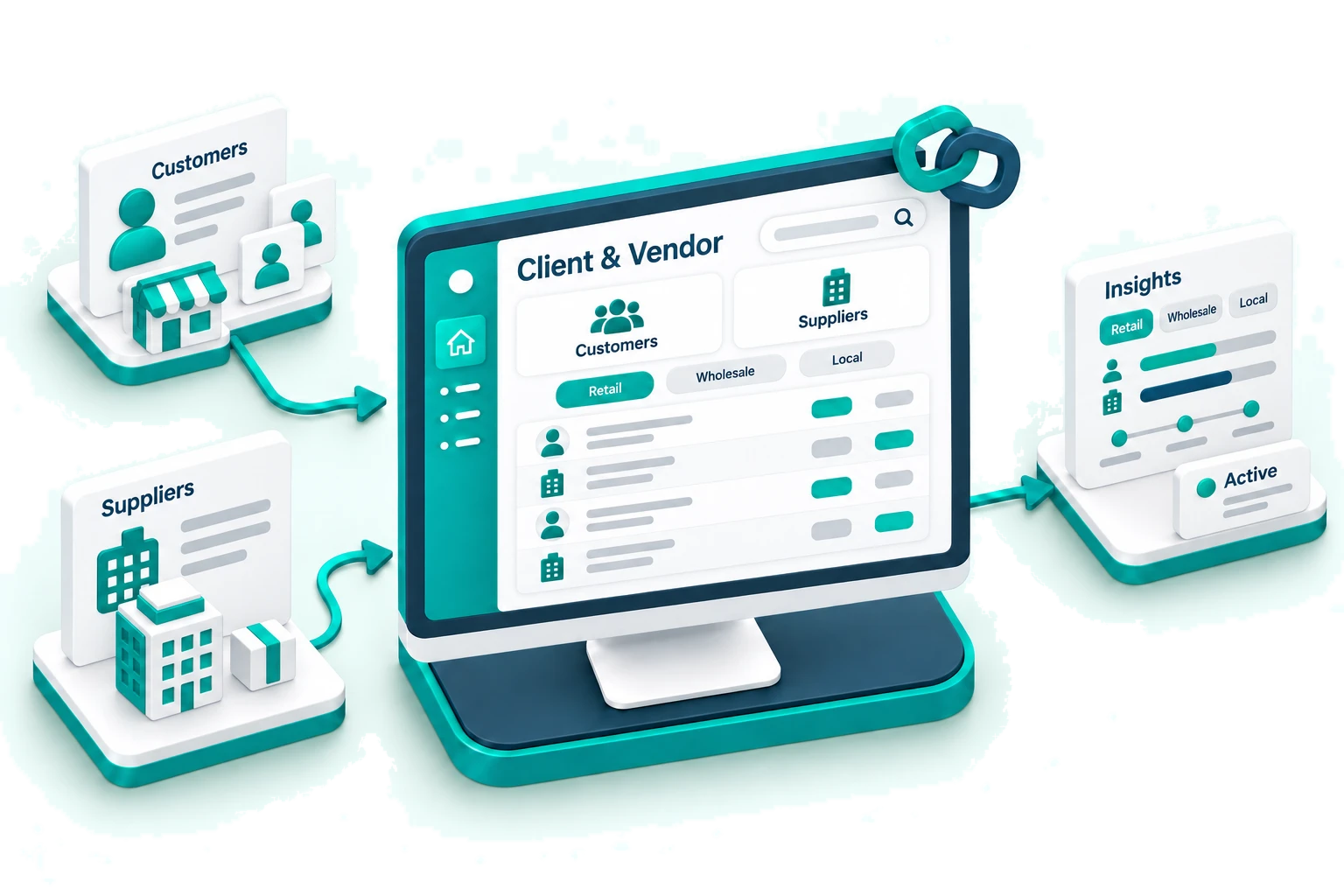
One page per customer, with everything they ever did on it
Not a contact list. Every quotation, delivery, invoice, payment and return that firm has been part of, and a running balance that says what they owe you today — without opening a second screen or asking accounts.
Nobody updates a customer record. It is the sum of what the sales desk, the storeroom, the shop counter and accounts have each done with that name on it.
Sales
Quotations
Orders
Invoices
Delivery
Deliveries
Returns
Point of Sale
Counter sales
Counter returns
Accounting
Payments
Credit memos
Running balance
One page per firm
With a ledger underneath it — date, the document it came from, debit, credit and the balance after it — so “what do they owe us” is read, not worked out.
And the same firm can sit on both sides. A customer record can be linked to a supplier record, and the customer list has a filter for exactly that — which is a good deal more common than most software assumes.
What is in it
Everything the Client & Vendor module covers
Customer Directory
Each one with a code, a type you defined, the date they became a customer and their own price list. Addresses go down to thana, with as many contact people and delivery addresses as they have.
The same record the other way round — supplier types, an opening balance, contact details — and every order, receipt, bill and payment you have ever run through them.
One page per firm: what they have ordered, taken delivery of, been invoiced and paid, what credit they are holding, and a ledger with a running balance underneath it all.
Set up once when they first buy from you, then it fills itself for as long as they keep trading.
Who they are
Name, code, type, the date they became a customer, and a photo or logo if you want one. Active or inactive rather than deleted.
Customer code
Customer type
Customer since
Status
Where they are
Billing and shipping addresses down to thana, and as many extra addresses and contact people as the firm has.
Address type
District
Thana
Contact person
What they pay
Their own price list, so a wholesale boutique and a walk-in customer are quoted correctly without anyone remembering to.
Price list
Opening balance
Customer type
What they owe
A ledger of every document with a running balance, plus credit memos issued, applied and still available.
Date
Reference
Debit / credit
Balance
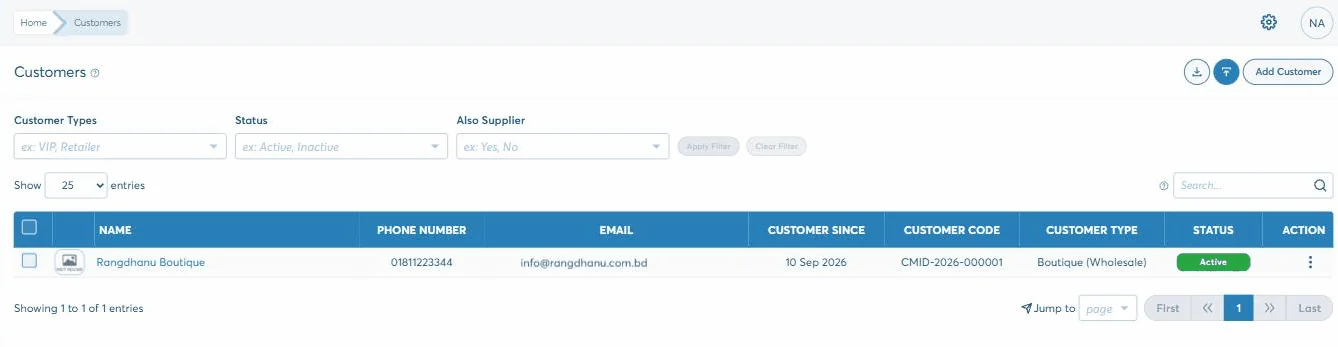
Each customer with their own code, their type and the date they started buying — and a filter for the ones who are suppliers too.
How it holds
Two things a contact list cannot do
Both are the difference between knowing who somebody is and knowing where you stand with them.
The balance is a consequence, not a field
Nobody types what a customer owes. The ledger lists every invoice, payment, return and credit memo in date order with a running balance, and each line names the document it came from — so a disputed figure is traced back to a specific invoice in one click rather than reconstructed from memory.
Total debit48,500.00
Total credit48,500.00
Difference0.00
A credit memo is tracked until it is used up
When you owe a customer money rather than goods, a customer debit is issued. What has been issued, what has been applied to later invoices and what is still available are three separate figures — so credit does not get forgotten by you or claimed twice by them.
Issued
Applied
Remaining
A firm you both buy from and sell to can be linked as customer and supplier, and the customer list filters on it.
Why it matters
Why the relationship needs its own page
Most businesses can tell you a customer’s phone number in seconds and what that customer owes in about a day and a half.
What they owe is read off a ledger, not worked out from invoices
Every figure links back to the document that caused it
Credit you owe them is tracked until it has actually been used
Their own price list means nobody has to remember the wholesale rate
Counter sales and order sales land on the same customer page
A firm you buy from and sell to is one relationship, linked on both sides
What comes out
What you can ask about a relationship
Nearly all of it is on the one page, which is the point of having the page at all.
What one customer owes, right now
Their ledger, document by document
Everything they have ordered
Everything delivered to them
Everything invoiced and everything paid
Credit memos issued, applied and remaining
Customers who are also suppliers
Customers by type — wholesale, retail, whatever you use
The supplier side mirrors it: every order, goods receipt, bill and payment against that supplier, and what you still owe them.
Getting started
How client & vendor gets running
How long it takes depends on how you work and what has to come across from wherever it lives now. That is what the second step is for — and nothing is committed before it.
1
Start the trial
30 days, no card, nothing to install. Put a real week of your own work through it rather than a demo of ours.
2
A short discovery
We go through how you actually work — the documents, who should see what, and what has to come across into client & vendor.
3
Set up and trained
Modules configured to that, roles set screen by screen, and your team taken through the parts they will each use.
4
Live, and still answered
Phone, email or online, from the team that built it. Nobody hands you to a reseller once the invoice is paid.
Questions
What a sales or accounts person asks about it
Can I see everything one customer has ever done?
That is what the customer page is. Orders, deliveries, invoices, payments, direct sales and credit memos each have their own tab, with a ledger underneath showing every one of them in date order against a running balance.
Where does the outstanding balance come from?
From the documents themselves. Every invoice, payment, return and credit memo posts to that customer’s ledger, and the balance is what those add up to. There is no field anyone can type it into, which is why it can be trusted.
Can one firm be both a customer and a supplier?
Yes. A customer record can be linked to an existing supplier record, and the customer list has an "Also Supplier" filter so you can pull them out. Both sides keep their own documents and their own balance.
Can different customers have different prices?
Yes — each customer can be put on a price list, and quotations, orders and invoices use it. A wholesale account and a retail one get their own rates without anyone having to remember which is which.
What happens to a customer who stops trading?
You make them inactive rather than delete them. The record and every document attached to it stay where they are, which is what you want when they reappear two years later or when an auditor asks.
How much address detail does it hold?
Billing and shipping addresses with country, division, district and thana, and as many additional addresses and contact people as the firm has — so a boutique with three branches and two people who order is one customer, not three.