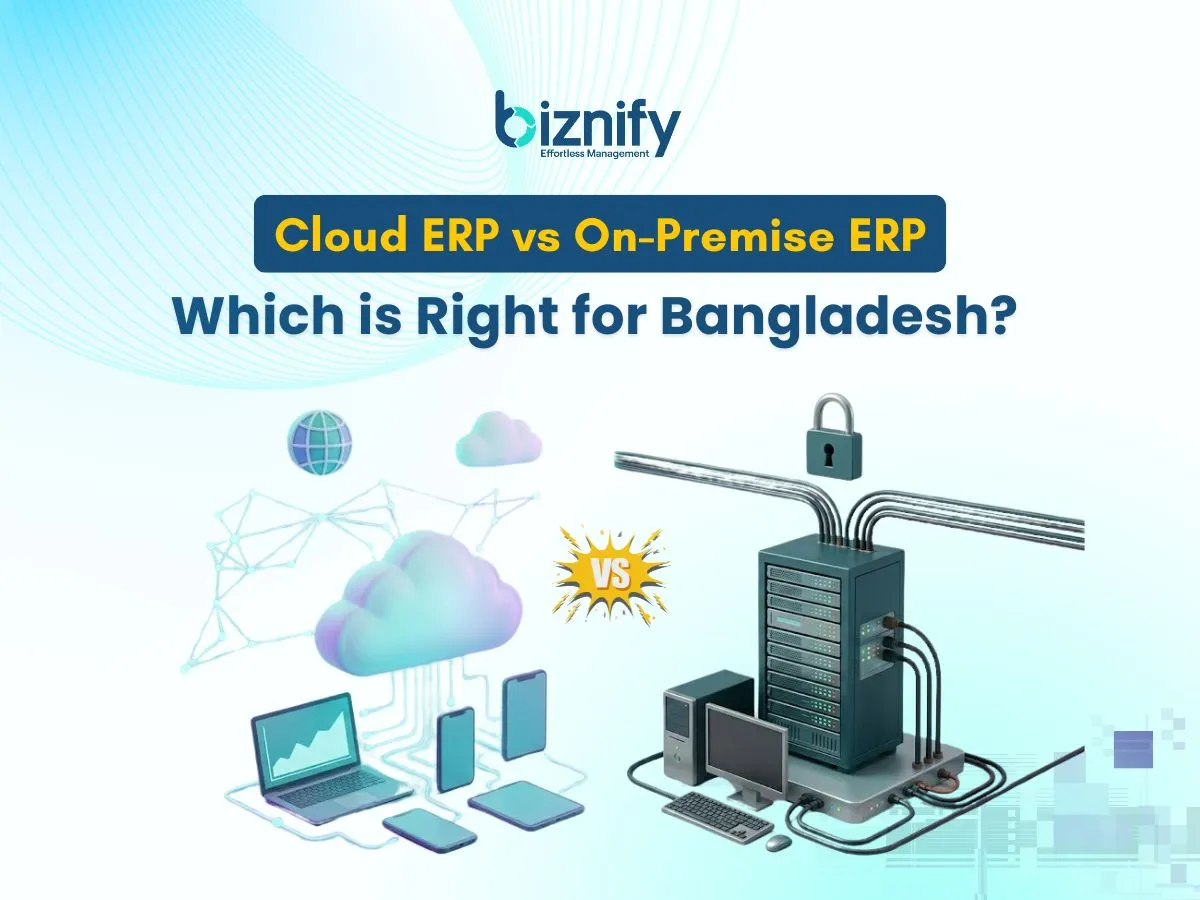
Cloud ERP is hosted on remote servers and accessed through the internet, while on-premise ERP is installed on your own local servers and managed by your in-house team. For most businesses in Bangladesh, cloud ERP is the better option because it costs less upfront, requires no IT infrastructure, and can be accessed from anywhere. ERP software in Bangladesh has shifted heavily toward cloud in recent years, and the gap keeps widening.
But the right choice depends on your business size, budget, IT capability, and how much control you need over your data. This guide breaks down every difference so you can make the right call.
What is Cloud ERP?
Cloud ERP is a software-as-a-service (SaaS) model where the ERP vendor hosts the system on their servers. You access it through a web browser or mobile app. The vendor handles all updates, security patches, backups, and server maintenance. You pay a monthly or annual subscription fee instead of a large one-time purchase.
Examples of cloud ERP in Bangladesh include Biznify, along with international options like Odoo Cloud and SAP Business One Cloud. Biznify is built specifically for Bangladesh businesses with BDT pricing, local payment gateway support, and a dedicated mobile app.
What is On-Premise ERP?
On-premise ERP is installed directly on servers located in your office or data center. Your IT team (or a hired consultant) manages the hardware, software updates, security, and backups. You typically pay a one-time license fee upfront, plus annual maintenance costs.
On-premise ERP providers in Bangladesh include solutions like Focus 9 (available in both cloud and on-premise), SAP on-premise installations, and custom-built systems from local development firms like Brain Station 23.
Cloud ERP vs On-Premise ERP - Key Differences
| Factor | Cloud ERP | On-Premise ERP |
|---|---|---|
| Upfront Cost | Low - monthly subscription (৳1,000-5,000/month) | High - license + hardware + setup (৳50,000-৳500,000+) |
| Ongoing Cost | Predictable monthly fee includes updates and support | Annual maintenance, server costs, and IT staff salaries |
| Implementation Time | Days to weeks | 3-12 months typically |
| IT Team Required | No - vendor handles everything | Yes - need dedicated IT staff or consultants |
| Access | Anywhere with an internet browser, mobile, tablet | Usually limited to the office network |
| Updates | Automatic - vendor pushes updates to all users | Manual - your IT team must install each update |
| Scalability | Add users or modules instantly | Requires new hardware and licenses |
| Customization | Configuration-based, with some limits on deep customization | Fully customizable source code access |
| Data Control | Stored on the vendor's cloud servers with encryption | Stored on your own physical servers |
| Security | Vendor provides enterprise-grade encryption, backups, and access control | You manage security - can be stronger or weaker depending on your IT team |
| Internet Dependency | Requires a stable internet connection | Works on the local network without internet |
| Best For | Growing businesses, multi-branch operations, and limited IT budget | Large enterprises with dedicated IT teams and regulatory requirements |
Why Cloud ERP Makes More Sense for Bangladesh Businesses
Bangladesh's business landscape has specific characteristics that make cloud ERP the practical choice for most companies. Here is why.
Lower entry barrier. Most businesses in Bangladesh operate with tight budgets. Cloud ERP eliminates the need for expensive servers, dedicated IT rooms, and full-time system administrators. With Biznify's plans starting at ৳1,000/month, a business can get accounting, inventory, POS, HR, and manufacturing modules running in days rather than months.
Multi-branch accessibility. If you run outlets in Dhaka, Chittagong, and Sylhet, cloud ERP lets every branch access the same system simultaneously. On-premise systems typically require expensive VPN setups or remote desktop configurations to achieve the same result.
No IT team needed. According to industry data, on-premise ERP requires at least 1-2 dedicated IT professionals for maintenance. For a business paying ৳25,000-40,000/month per IT staff member, that is a high recurring cost that cloud ERP eliminates entirely.
Automatic updates. Cloud ERP vendors push updates automatically. You always have the latest features and security patches without scheduling downtime or paying consultants for upgrade projects.
Mobile access. Cloud platforms like Biznify offer dedicated mobile apps, allowing business owners to check reports, approve orders, and monitor inventory from their phones. On-premise systems rarely offer this without additional custom development.
When On-Premise ERP Might Be the Right Choice
On-premise ERP is not obsolete. It still makes sense in specific situations.
Regulatory data residency. Some industries require data to be stored on local servers within Bangladesh. If your business falls under strict data governance policies, on-premises gives you full physical control over where your data lives.
Deep customization needs. If your business processes are highly unique and require modifying the ERP source code, on-premise systems offer more flexibility. Cloud ERP is configurable but has limits on core code changes.
Unreliable internet. If your primary business location has frequent internet outages and you cannot afford backup connectivity, on-premise ERP runs on your local network independently.
Large enterprise with existing IT infrastructure. If you already have servers, a data center, and an IT team managing other systems, the incremental cost of adding on-premise ERP is lower than it would be for a business starting from scratch.
Cost Comparison - Cloud vs On-Premise Over 3 Years
| Cost Category | Cloud ERP (3 Years) | On-Premise ERP (3 Years) |
|---|---|---|
| Software License / Subscription | ৳36,000-180,000 (monthly subscription × 36) | ৳100,000-500,000 (one-time license) |
| Server Hardware | ৳0 (included) | ৳50,000-200,000 |
| IT Staff / Maintenance | ৳0 (vendor handles) | ৳900,000-1,440,000 (৳25K-40K/month × 36) |
| Updates & Upgrades | ৳0 (included in subscription) | ৳50,000-150,000 (annual maintenance fee) |
| Implementation / Setup | ৳0-10,000 | ৳100,000-500,000 (consulting) |
| 3-Year Total | ৳36,000-190,000 | ৳1,200,000-2,790,000 |
For most businesses in Bangladesh, cloud ERP costs 5-15x less over a 3-year period when you factor in IT staff and hardware. The on-premise model only becomes cost-competitive for very large enterprises with 100+ users and existing infrastructure.
How to Decide - A Simple Framework
Choose cloud ERP if: You have fewer than 200 employees, no dedicated IT team, need multi-branch access, want to start quickly with low investment, or prefer predictable monthly costs.
Choose on-premise ERP if: You have strict data residency requirements, need deep source-code customization, have unreliable internet with no backup, or already maintain your own server infrastructure with IT staff.
Consider hybrid: Some businesses use cloud ERP for most operations but keep specific sensitive data on local servers. This is becoming more common as internet reliability improves across Bangladesh.
How Biznify Fits In
Biznify is a cloud-based ERP software designed specifically for the local market. It includes accounting, inventory management, POS, HR & payroll, manufacturing, and sales modules in one platform. Plans start at ৳1,000/month with a 14-day free trial and no credit card required.
For businesses that want the benefits of cloud ERP without the complexity of international platforms like SAP or Oracle, Biznify offers a purpose-built solution with BDT pricing, local payment gateway support, and a mobile app for on-the-go management.
Start your free trial to see how cloud ERP works for your business.
Frequently Asked Questions
Is cloud ERP safe for storing business data?
Yes. Cloud ERP providers use enterprise-grade encryption, regular backups, and role-based access control. Your data is typically safer in a professionally managed cloud environment than on a local server without dedicated security staff.
Can I switch from on-premise to cloud ERP later?
Yes. Most cloud ERP providers offer data migration support. The process involves exporting your data from the old system and importing it into the cloud platform. Biznify's team provides migration assistance during onboarding.
Does cloud ERP work without internet?
Cloud ERP requires an internet connection to function. If your location has frequent outages, consider a mobile data backup or choose a platform with offline capabilities for critical functions like POS billing.
Which is more popular in Bangladesh - cloud or on-premise?
Cloud ERP adoption is growing rapidly in Bangladesh, especially among businesses that want affordable, scalable solutions without IT overhead. On-premise still exists in larger enterprises and government organizations with specific infrastructure requirements.
How long does cloud ERP take to implement?
Most cloud ERP systems can be set up in days to a few weeks. Biznify offers same-day setup for basic configurations, with full onboarding support to help you add products, employees, and a chart of accounts within the first week.
Can cloud ERP handle multiple branches in different cities?
Yes. Cloud ERP is accessed through the internet, so all branches in Dhaka, Chittagong, Sylhet, or any location can access the same system simultaneously with real-time data sync.