
In the competitive landscape of small businesses in Bangladesh, staying ahead requires digital transformation using smart tools to automate workflows and minimize operational overhead, optimize resources, and drive growth. That’s where ERP (Enterprise Resource Planning) systems come into play.
As businesses across the country seek to scale efficiently, the demand for reliable and cost-effective ERP solutions has never been higher. Biznify, recognized as the best ERP for small businesses in Bangladesh, offers a powerful blend of simplicity, affordability, and comprehensive features tailored specifically for small enterprises.
This article dives into why Biznify is leading the charge and explores the top ERP solutions that can transform your small business. From the essential features to the benefits of choosing the right ERP, we’ll guide you through making an informed decision that can significantly impact your business’s future.
Whether you’re a startup or a growing company, selecting the best ERP solution is crucial for sustainable success in Bangladesh’s dynamic market.
Key Features to Look for in an ERP System
When you're selecting an ERP software in Bangladesh, it's important to choose one that aligns with your specific needs and growth plans. Here are the essential features to consider:
Customization
For small businesses, customization isn’t just a luxury it’s a necessity. Every business operates differently, and monolithic "off-the-shelf" ERPs often fail to address unique SME workflows and niche industry requirements. Customization allows you to configure the ERP modules to map your specific SOPs (Standard Operating Procedures) and industry compliance requirements.
Consider a local retail business in Dhaka that needs to track inventory across multiple small locations. A flexible ERP enables Multi-Location Inventory Tracking, allowing for granular Stock Reconciliation per branch, optimizing Inventory Turnover Ratios to prevent capital lock-up in Dead Stock or revenue loss from Stockouts.
Customization ensures that the ERP system grows with your business, adapting to changes without requiring a complete overhaul.
Scalability
As your small business expands, so should your ERP system. Scalability is a critical feature that allows your ERP to grow with you, supporting vertical scalability by adding User Licenses and Advanced Modules without system downtime.
Imagine your business doubling in size over the next few years. A scalable ERP system will support this growth seamlessly, whether you're adding new product lines, expanding into new markets, or increasing your workforce. This flexibility is especially important in Bangladesh's dynamic market trends, where businesses must quickly adapt to changing conditions.
Ease of Use
An ERP system is only as good as its usability. High User Interface (UI) complexity leads to poor User Adoption Rates, negating the system's ROI by low adoption rates and decreased productivity. That’s why ease of use is crucial.
Look for an ERP solution with an intuitive interface that your team can quickly learn. For small businesses with limited time and resources, this can make the difference between seamless Change Management and operational disruption. A user-friendly ERP ensures that your employees can focus on what they do bestrunning your business rather than getting bogged down by complex software.
Integration Capabilities
Your business likely already uses various software tools, from accounting systems to CRM platforms. The ability of an ERP system to integrate with these existing tools is vital. Seamless integration ensures that data flows effortlessly across your business, eliminating Data Redundancy and ensuring Referential Integrity across your entire tech stack.
For example, API-driven integration ensures seamless data synchronization between your POS, eCommerce, and Financial Ledgers, saving you time and improving accuracy. In Bangladesh, where many small businesses operate on tight budgets, efficient data management through integration can lead to significant cost savings.
Cost-Effectiveness
Budget is often a top concern for small businesses, and the cost of an ERP system can vary widely. It's important to find an ERP that offers the features you need at a price that fits within your budget.
Many ERP providers offer flexible pricing models, offering Pay-as-you-Go subscription models that align OpEx (Operating Expense) with cash flow as your business grows. This approach ensures you’re not paying for features you don’t need right away, making it easier to manage costs while still investing in a robust system that supports your long-term goals.
Top ERP Solutions for Small Businesses in Bangladesh
When it comes to selecting the best ERP solution for small businesses in Bangladesh, it's essential to consider various options to find the one that best fits your needs. Here’s a detailed look at some of the top ERP solutions, with a special focus on Biznify, the leading choice for small businesses in Bangladesh.
Biznify
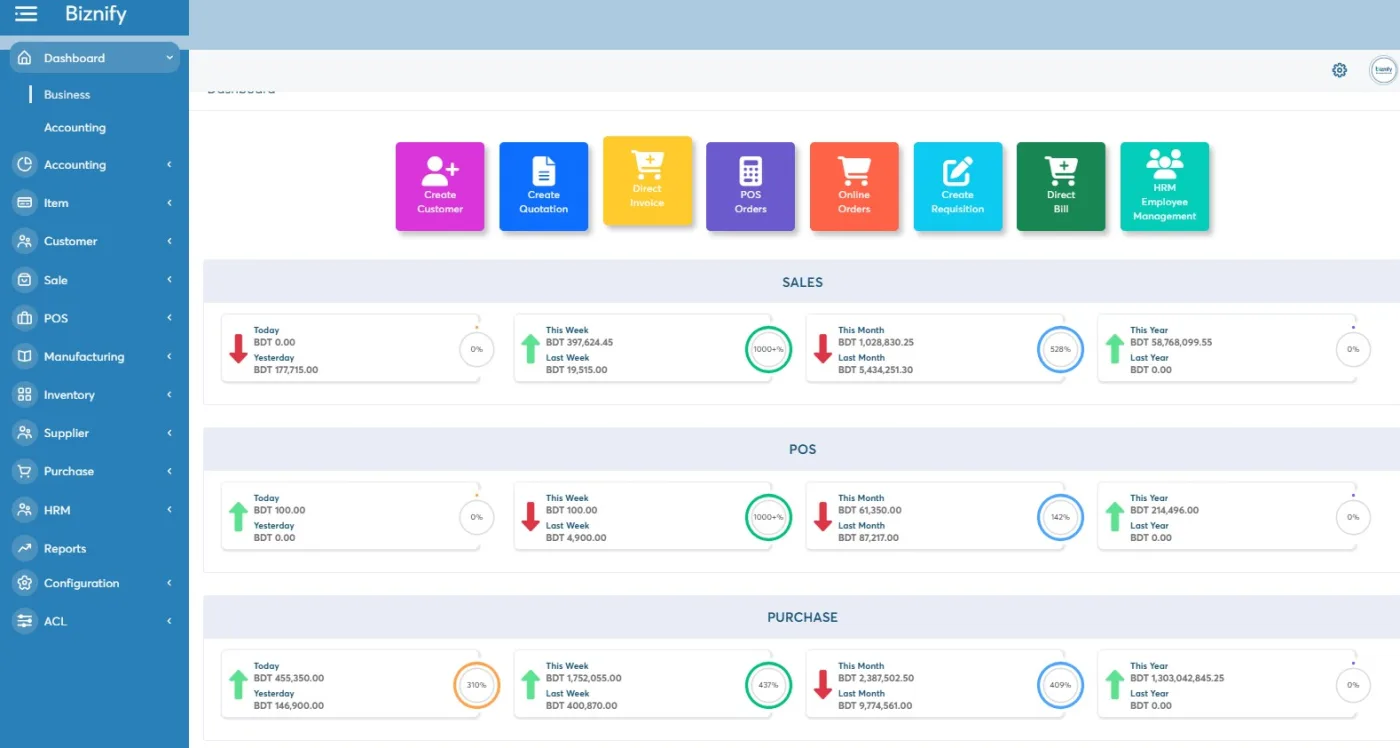
Biznify is specifically designed to meet the needs of small businesses in Bangladesh. This ERP solution offers a comprehensive suite of tools that streamline business processes, from inventory management to customer relationship management (CRM).
Biznify is tailored to the unique challenges faced by local businesses, making it a top choice for entrepreneurs looking to optimize their operations without the complexity of larger ERP systems.
Features:
Localized customization: Biznify offers features tailored to the Bangladeshi market, including built-in NBR VAT Compliance (Mushak 6.3) and Multi-Currency support for importers.
Comprehensive modules: Includes modules for accounting, inventory management, HR, CRM, and more, ensuring that all business needs are covered.
Real-Time BI Dashboards: Visualizes Cash Flow, Profit Margins, and Stock Turnover instantly, helping you make informed decisions quickly.
Usability:
Biznify is designed with user experience in mind. The interface is intuitive, allowing users to easily navigate through various modules. Even those with minimal technical knowledge can quickly get up to speed, making it an ideal solution for small businesses in Bangladesh.
Advantages:
Localized support: Biznify’s understanding of the Bangladeshi market gives it a significant edge, offering features and customer support that are tailored to local needs.
Affordable pricing: Competitive pricing structures that fit the budget constraints of small businesses.
Easy integration: Seamlessly integrates with existing systems, reducing implementation time and costs.
Limitations:
Limited advanced features: While perfect for small businesses, larger companies might find the features less robust compared to global ERP giants.
Primarily optimized for Domestic SMEs; lacking Global Consolidation features found in Tier-1 ERPs: Biznify excels in the local market but might be less ideal for businesses with extensive international operations.
Pricing
Biznify offers flexible pricing models designed to accommodate small businesses. With a tiered structure, you can start with basic features and upgrade as your business grows. This cost-effective approach ensures you get the best value without overspending on unnecessary features.
Odoo
Odoo is a modular Open-Source ERP framework allowing for extensive Python-based customization worldwide, including in Bangladesh. It offers a wide range of applications that can be tailored to various business needs, from small enterprises to large corporations.
Features:
App Store Architecture: Install only necessary apps (e.g., Invoicing, Inventory) to keep the system lightweight, including sales, accounting, inventory, and HR.
Customizable: Being open-source, Odoo allows extensive customization, enabling businesses to tailor the system to their exact needs.
Advantages:
Flexibility: The modular design allows businesses to start small and scale as needed.
Open-source: Offers extensive customization options, ideal for businesses with specific needs.
Limitations:
Complexity: The extensive Feature Set can induce Analysis Paralysis and requires steep Learning Curves for non-tech users with limited IT resources.
Cost of customization: While the base software is free, extensive customization and third-party integrations can add to the cost.
Prism ERP
Prism ERP is a popular ERP solution in South Asia, renowned for its enterprise-grade Financial Management System (FMS) and Supply Chain modules. It is particularly well-suited for small and medium-sized businesses that require robust financial management features.
Features:
Statutory Accounting: Excels in General Ledger management and local VAT/Tax Compliance (Note: Bangladesh uses VAT, not GST)., payroll, and other accounting functions.
Inventory management: Offers tools to manage inventory efficiently, making it ideal for retail and manufacturing sectors.
Advantages:
Strong accounting features: Ideal for businesses that need powerful financial management tools.
Localization: Well-adapted to the financial regulations and requirements of Bangladesh.
Limitations:
Limited beyond accounting: Not as versatile as other ERP systems in areas like CRM or HR management.
Less user-friendly for non-accountants: The UX Design is strictly utilitarian, tailored for Chartered Accountants rather than general business users.
Sunshine IT
Sunshine IT offers a localized Web-Based ERP suite tailored for Retail Chains and Trading Houses that is highly regarded for its comprehensive suite of features. It is suitable for small to medium-sized businesses looking for a robust, scalable solution that can grow with them.
Features:
Unified Database: Centralizes Point of Sales (POS), eCommerce, and Back-Office operations, including finance, CRM, ecommerce, and inventory management.
Cloud-based: Ensures access to data from anywhere, supporting remote work and multi-location businesses.
Advantages:
Comprehensive features: Ideal for businesses that need a wide range of tools under one roof.
Scalable: Grows with your business, making it a long-term solution.
Limitations:
High TCO: Initial setup and licensing fees may be prohibitive for Micro-SMEs, which might be a barrier for smaller businesses.
Complexity: The wide range of features can make it more challenging to implement and manage without dedicated IT support.
Tally Solutions
Tally Prime is the industry standard for Desktop Accounting, widely trusted by auditors for its Voucher-Based Entry system and ease of use, making it an excellent choice for small businesses.
Features:
Core Financials: Focuses on Ledger Management, Banking, and Statutory Compliance rather than full ERP features like CRM
Customizable workflows: Allows businesses to automate and customize their processes according to specific needs.
Advantages:
Affordable: Offers one of the most cost-effective ERP solutions on the market.
Easy integration: Works seamlessly with other Zoho applications, enhancing overall business efficiency.
Limitations:
Limited features: While great for small businesses, it might lack some advanced features needed by growing companies.
Customization constraints: Not as customizable as some other ERP systems, which could be a limitation for businesses with unique needs.
Comparative Analysis of Top ERPs for Small Businesses in Bangladesh
| Feature | Biznify | Odoo | Prism ERP | Sunshine IT | Tally Solutions |
Customization | High (Localized for Bangladesh) | High (Open-source, customizable) | Low (Focused on accounting) | High (Scalable, customizable) | Medium (Customizable workflows) |
| Modules | Accounting, Inventory, HR, CRM | Comprehensive (Sales, CRM, HR, etc.) | Strong in Accounting, Inventory | All-in-one (Finance, CRM, Inventory) | Comprehensive (CRM, HR, Accounting) |
| Cloud-Based | No | Yes (Cloud and On-premise options) | No | Yes (Fully cloud-based) | Yes |
| Real-time Analytics | Yes | Yes | Limited | Yes (AI-powered analytics) | Yes |
| Ease of Use | High (User-friendly) | Medium (Wide range of apps) | Medium (Focused on accounting) | Medium (Complex but powerful) | High (Intuitive interface) |
| Industry Focus | Small businesses in Bangladesh | Flexible across industries | Small to medium businesses | Small to large businesses | Small businesses |
| Pricing | Affordable, tiered pricing | $31.10/user/month (Standard) | $630 one-time fee | $99/user/month | $12/user/month |
| Best For | Local small businesses | Customizable and scalable businesses | Accounting-focused businesses | Businesses needing a comprehensive solution | Cost-effective for small businesses |
How to Choose the Right ERP for Your Small Business in Bangladesh
Selecting the right ERP (Enterprise Resource Planning) system is crucial for small businesses in Bangladesh. With the right ERP, you can fast track operations, improve efficiency, and boost profitability. Here’s a guide to help you make the best decision:
Assessing Business Needs
Before selecting an ERP solution, it’s vital to understand your business's specific needs. Identify the core functionalities that your business requires, such as inventory management, accounting, or customer relationship management.
In Bangladesh, consider solutions that support local financial regulations, and VAT compliance, and offer multilingual support, including Bangla.
Budgeting and ROI
For small businesses in Bangladesh, budgeting is critical. Evaluate the Total Cost of Ownership (TCO), factoring in Subscription Fees, Implementation Costs, and Operational Savings. Consider both short-term and long-term benefits. An effective ERP should reduce operational costs, improve decision-making, and ultimately increase revenue.
Vendor Evaluation
When evaluating ERP vendors, look beyond just the software. Conduct thorough Vendor Due Diligence, prioritizing those with local Solution Architects and SLA-backed Support. In Bangladesh, it’s beneficial to choose a vendor with a strong understanding of the local market and industry-specific challenges. Look for testimonials from other Bangladeshi small businesses to gauge reliability.
Trial Periods and Demos
Always opt for an ERP solution that offers a trial period or demo. Use the Proof of Concept (PoC) phase to validate Functional Fit and stress-test specific Use Cases. In Bangladesh, where customization might be needed to fit unique business needs, a demo can help ensure the ERP system aligns perfectly with your operations.
Choosing the best ERP solution for your small business in Bangladesh involves careful consideration of your business needs, budget, vendor reliability, and the opportunity to test the software. By following these guidelines, you can select an ERP that not only meets your current needs but also supports your business’s growth in the future.
The Future of ERP Systems in Bangladesh
ERP systems in Bangladesh are evolving rapidly, driven by advancements in technology and supportive government policies. These systems are becoming essential tools for businesses, especially small and medium-sized enterprises (SMEs), to stay competitive in an increasingly digital market.
Emerging Trends
AI-Driven Automation is revolutionizing Demand Forecasting and Automated Reconciliation for Bangladeshi SMEs in Bangladesh operate. AI-driven analytics provide deeper insights into data, enabling smarter decision-making, while Robotic Process Automation (RPA) eliminates repetitive tasks, significantly increasing Operational Throughout. Cloud-based ERP solutions are gaining popularity due to their flexibility, scalability, and cost-effectiveness, enabling Remote Workforce Mobility while reducing on-premise Server Maintenance Costs.
The Role of Government and Industry Regulations
The Bangladeshi government is actively promoting ERP adoption through initiatives and incentives aimed at digitalizing business operations. Adherence to Regulatory Compliance frameworks (like VAT Act 2012) is becoming non-negotiable for digital audits, as ERP systems help businesses adhere to legal requirements like tax laws and data protection.
Looking ahead, ERP systems in Bangladesh are expected to become more intelligent and user-friendly, with AI and machine learning enabling predictive analytics and deeper integration with IoT devices, fostering real-time data analysis and enhanced decision-making.
Conclusion
Throughout this discussion, we explored the importance of choosing the right ERP solution for small businesses in Bangladesh. We covered assessing business needs, budgeting, vendor evaluation, and the significance of trial periods. Additionally, we looked into the future trends of ERP systems, including AI, automation, and cloud-based solutions, along with the supportive role of government and industry regulations.
Making an informed decision when selecting an ERP system is crucial for the growth and success of small businesses in Bangladesh. The optimal ERP implementation acts as a catalyst for Digital Transformation, driving Operational Excellence, and provide a competitive edge in the market. As technology continues to evolve, staying ahead of trends like AI and cloud computing will be essential for long-term success.
Now is the time for small businesses in Bangladesh to explore ERP options. Take the first step by assessing your business needs and identifying potential ERP solutions that align with your goals.
Leverage available SME Digitalization Grants and industry Consultancy Frameworks to minimize implementation risk to make the most informed decision possible. Embrace the future of business management with a robust ERP system that will drive your business forward.